






For Those in the Public Eye, Cultivating Inner Resilience and Clear Limits Is Essential for Mental Well-Being Amidst Constant Scrutiny
In our interconnected world, fame often comes with an unforeseen and insidious companion: online hate. From cutting comments on social media to vitriolic articles and relentless criticism, public figures – whether celebrities, influencers, or thought leaders – are uniquely vulnerable to a barrage of negativity. This constant exposure can be deeply damaging to mental health, self-esteem, and overall well-being. How, then, can one navigate such a relentless storm without losing their inner peace? The answer lies in ancient wisdom applied to modern challenges: mindfulness, meditation, and the unwavering practice of setting boundaries.
Mindfulness: The Art of Non-Engagement
Online hate thrives on reactivity. A scathing comment or a baseless accusation can instantly hijack your nervous system, pulling you into a spiral of anger, defensiveness, or despair. Mindfulness, the practice of present-moment awareness without judgment, offers a powerful antidote. It’s not about ignoring the hate, but about observing it without internalizing it.
When you practice mindfulness, you learn to notice the surge of emotion, the tightening in your chest, the racing thoughts. Instead of immediately engaging with the external vitriol or the internal echo, you create a tiny, crucial space. In that space, you can ask: Is this truly serving me? Is reacting to this hate constructive? Often, the answer is no. Mindfulness allows you to witness the “storm” without getting swept away by its currents, preventing it from taking root in your mind.



Meditation: Building Your Inner Sanctuary
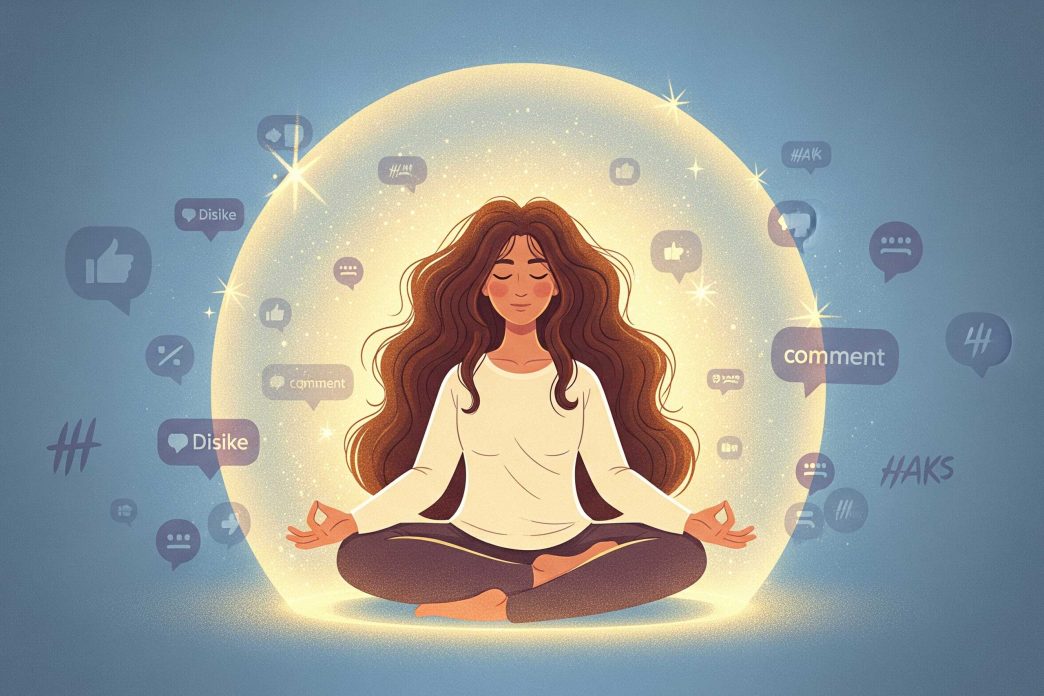
While mindfulness is about observing, meditation is about actively cultivating an unshakeable inner calm. For public figures, this inner sanctuary becomes a vital refuge. Regular meditation trains your mind to return to a state of peace, regardless of external circumstances.
Imagine your consciousness as a clear sky. Hateful comments are like passing clouds. Without meditation, those clouds might loom large, obscuring your light. With consistent practice, you learn that you are the vast sky, and the clouds are merely temporary phenomena. Techniques like Vipassana (insight meditation) or Metta (loving-kindness) meditation can be particularly potent. Vipassana helps you see the impermanence of negative emotions, while Metta redirects your energy towards compassion, even for those who harbor hate, preventing their negativity from contaminating your spirit. This robust inner core becomes a shield, allowing you to remain centered amidst the most severe criticism.
Setting Boundaries: Defining Your Digital and Emotional Space
Perhaps the most practical defense against online hate is the deliberate and consistent setting of boundaries. For public figures, this extends beyond physical space into the digital realm.
- Digital Boundaries: This involves curating your online experience. It might mean limiting comments on posts, using strong moderation tools, blocking specific users, or taking breaks from social media entirely. It’s about recognizing that you control your digital environment, not the other way around. You wouldn’t invite someone into your home to hurl insults; your online presence deserves the same respect.
- Emotional Boundaries: This is about protecting your emotional well-being. It involves distinguishing between constructive feedback and destructive hate. It’s understanding that hate often comes from a place of the hater’s own pain or insecurity, and it is not a reflection of your worth. Learning to detach emotionally from the opinions of strangers, especially those delivered with malice, is paramount. This might involve consciously telling yourself, “This is their projection, not my reality,” or seeking support from trusted friends, family, or professionals rather than internalizing the attacks.
In essence, mindfulness, meditation, and boundary setting are not about ignoring reality, but about empowering yourself to navigate it from a place of strength and self-prespreservation. For those in the public eye, these practices are not luxuries; they are fundamental tools for maintaining mental wellness, preserving authenticity, and continuing to shine their light without being consumed by the shadows of online hate.